
A Legacy of Secrets and the Modern Search for Meaning
When Dan Brown’s The Da Vinci Code first reached readers, it sparked a global fascination with the untold stories behind religious institutions. Ancient codes, clandestine societies, and a sacred bloodline hidden in plain sight — Brown’s novel transformed sacred history into a puzzle begging to be solved. But behind the suspense was a deeper cultural hunger. One that had less to do with decoding symbols and more to do with confronting the boundaries of belief.
Twenty years later, Robert Parsons’ Joseph’s Letter picks up where Brown left off — not by echoing his style, but by evolving the conversation. This is not simply a religious thriller; it is a philosophical provocation that demands the reader reckon with one question: What if the truth you uncover doesn’t set you free, but leaves you unmoored?
Where The Da Vinci Code made heresy thrilling, Joseph’s Letter renders truth uncomfortable. And in an era marked by institutional distrust, spiritual disaffiliation, and post-truth politics, that makes Parsons’ novel deeply resonant.
Let’s explore three core thematic parallels that make this book a spiritual successor to Brown’s work — and, in many ways, a more profound continuation of the cultural debate he reignited.

I. Ancient Secrets:
Hidden Bloodline vs. Lost Scroll — The Quest for Origins
In The Da Vinci Code, the idea of Jesus fathering a child with Mary Magdalene is not just controversial. It is explosive. It reframes Christian history through a human lens, suggesting the divine was not celestially removed, but intimately mortal. This repositioning of Christ as fully human — lover, father, partner — threatens the theological narrative upon which Church authority rests.
In Joseph’s Letter, the destabilizing artifact is not a lineage, but a document. A scroll allegedly written by Joseph of Arimathea — the man who gave Jesus his tomb. Titled Veritas Simplicitas (Latin for “Simple Truth”), this lost letter contains information that could scientifically affirm the authenticity of the Shroud of Turin, the cloth believed by many to bear the image of the crucified Christ.
Here, Parsons asks the reader to consider a different theological disruption: what happens when a relic long dismissed by science is proven authentic? Or worse — when a Church with the power to test it chooses not to?
Unlike the Grail, which remains metaphorical, the scroll in Joseph’s Letter is positioned as potentially verifiable. Its existence could upend centuries of theological debate. But more than that, it would expose the lengths to which religious and political institutions will go to maintain their versions of truth.
“Joseph’s Letter is essentially about a search for answers to secrets kept for more than 2000 years.” — Robert Parsons
The ancient secret, in this case, is not merely about Jesus. It is about the systems that have risen in his name — and the fear that unearthing the past might force a reckoning they are unprepared to face.s expected of them?
Psychologists argue that repetitive rituals can reinforce belief over time, as shown in studies on ritual behaviors and cognitive conditioning.
Research from the American Psychological Association suggests that repeated religious practices can create a deep-seated sense of identity and belonging, sometimes independent of personal conviction, even if the participant starts off without conviction. The act of kneeling, praying, and repeating sacred words can instill a sense of faith through repetition alone, rather than personal conviction.
Read more about the psychology of rituals.
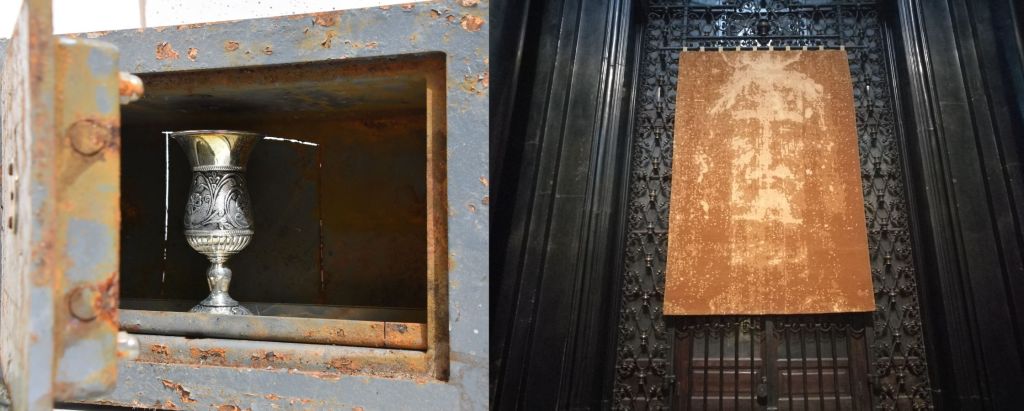
II. Sacred Relics:
The Grail vs. The Shroud — Tangibility, Evidence, and the Materiality of Belief
Brown’s Holy Grail, interpreted as both a physical vessel and symbolic womb, is never actually seen. It exists in the realm of the speculative — an idea more than an object. Its power lies in its suggestion of suppressed knowledge and the Church’s fear of the divine feminine.
Parsons, on the other hand, chooses a relic that is very much visible and endlessly debated: the Shroud of Turin.
Unlike the Grail, the Shroud has been subjected to scientific scrutiny. It has been carbon dated, examined for pollen samples, tested for blood residue, and photographed extensively. Yet, like the Grail, its meaning is uncertain. Its authenticity remains a matter of fierce debate among theologians, scientists, and skeptics.
What makes the Shroud so fascinating is not just whether it is real — but what people need it to be.
In Joseph’s Letter, the Shroud functions as a symbol of unresolved tension between faith and empiricism. For the protagonist Michael Battersby — a journalist turned reluctant seeker — it becomes the gravitational center of grief, legacy, and unanswered questions. His late wife Margaret was quietly studying the Shroud and the Joseph scroll for years. Her hidden research sends Michael down a path that is as personal as it is political.
“This story does not chase relics for the sake of discovery. It asks why we cling to them in the first place.”
This line captures what distinguishes Joseph’s Letter from its predecessor. The novel does not use relics to uncover a thrilling truth. It uses them to interrogate the emotional architecture of belief — why we need physical proof to validate spiritual experience, and what happens when that proof undermines what we thought we knew.

III. Religious Conspiracy:
Church as Suppressor of Power vs. Church as Manager of Instability
In The Da Vinci Code, the Church operates as a guardian of tradition and suppressor of truth. Its motive is power preservation. The threat of a divine bloodline could destabilize its male-dominated authority, so the truth must remain hidden.
In Joseph’s Letter, the institutional motives are more complex. Parsons portrays the Vatican — and even global intelligence agencies — as protectors of civilizational stability. Verifying the Shroud’s authenticity is not simply a religious question. It is a political one. Cardinal O’Grady warns that doing so could “undermine the basis of Christianity and cause serious instability throughout the Americas and other parts of the world.”
This framing shifts the question from power to chaos. The Church is not hiding the truth out of greed, but out of fear. And while this does not justify secrecy, it introduces a deeply modern dilemma:
What if revealing the truth unravels not only doctrine, but identity, culture, and societal cohesion?
This is where Parsons’ novel enters philosophical territory. It is not just about faith versus reason. It is about whether the human psyche can survive radical truth. In an age where conspiracy theories thrive, institutions fracture, and reality itself is contested, Joseph’s Letter asks what level of truth we are actually ready to receive — and what we will destroy to keep things as they are.
Conclusion: A Spiritual Successor for the Post-Truth Era
The Da Vinci Code gave readers permission to doubt. Joseph’s Letter goes a step further. It asks what we will do when doubt turns to confirmation — when what we feared might be true becomes undeniable.
This novel is not merely a thriller. It is a meditation on grief, faith, and the ethics of knowledge. It bridges theology, psychology, and geopolitics in a way that feels both intimate and terrifyingly relevant.
For readers drawn to the thrill of decoding history, Joseph’s Letter offers all the elements: a mysterious scroll, an ancient relic, an institutional cover-up. But for those willing to go deeper, it delivers something more profound — an invitation to re-examine not just what we believe, but why.
If you loved The Da Vinci Code for its daring, read Joseph’s Letter for its depth. Then ask yourself: If truth really does set us free, what part of you is still afraid to hear it?
📘 Read the first chapter of Joseph’s Letter by Robert Parsons FREE.
 Robert Parsons