
What if the seeds of extremism aren’t sown in rage, but in reverence?
What if the structures we trust to shape virtue—faith, discipline, tradition—can also lay the groundwork for something darker?
These aren’t easy questions. Nor are they rhetorical. They ask us to sit with discomfort. To hold the tension between upbringing and ideology, between belief and manipulation, between innocence and the capacity for harm.
When we examine the early life of Adolf Hitler, and the troubling endurance of neo-Nazi ideologies across generations, we are not seeking blame—we are seeking understanding. Not to excuse, but to uncover.
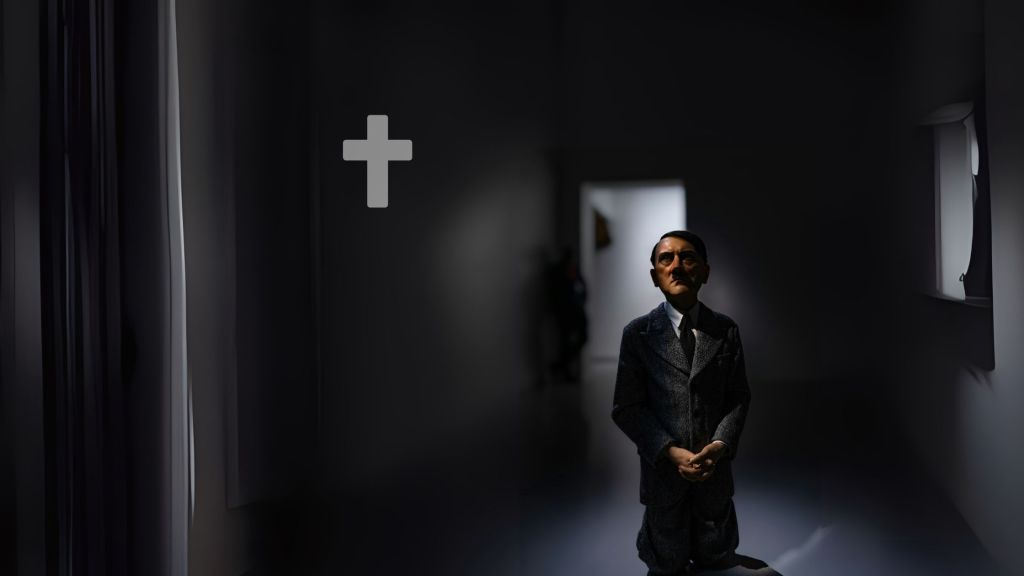
Adolf Hitler’s rise to power and the enduring presence of neo-Nazi ideologies are frequently examined through political, economic, and psychological lenses—but rarely through the formative religious and disciplinary environments that shaped his worldview.
When we trace the pathways of extremist belief systems, from Hitler’s early Catholic upbringing to today’s intergenerational transmission of white supremacist ideologies, a complex picture emerges—one where structured religion, authoritarian discipline, and inherited ideology intersect in subtle but powerful ways.

From Choirboy to Dictator: The Catholic Foundations of Hitler’s Youth
Born into a Catholic household in 1889, Adolf Hitler was baptized and raised in a Church that, at the time, was one of the few stable institutions in the Austro-Hungarian Empire.
His mother, Klara, was a devout practitioner, and young Adolf participated in choir and religious schooling, even aspiring to the priesthood at one point. His schooling at a Benedictine monastery immersed him in the sensory and hierarchical traditions of Catholicism—pageantry, obedience, and symbolic authority.
But while Catholic ritual captivated him as a child, it was also bound tightly with rigid discipline and authoritarian control. This early exposure to a system of unbending rules and sacred hierarchies planted seeds that would later resurface in his embrace of fascist ideology.
Though Hitler would ultimately abandon the Church, the structural and psychological frameworks of religious authority—the demand for obedience, the valorization of suffering, and the binary logic of good versus evil—never truly left him.
Catholic Discipline and Authoritarian Conditioning
The educational environment of early 20th-century Austria was steeped in regimentation. Catholic schools, in particular, emphasized discipline over inquiry, hierarchy over dialogue. Scholars have noted that this style of religious instruction, focused on control and conformity, may have reinforced the authoritarian tendencies that later found expression in Nazi ideology.
While it’s a dangerous oversimplification to draw a straight line from Catholic schooling to fascism, it is critical to examine how formative experiences with power and obedience can shape a worldview.
Hitler’s immersion in a system that valued silence, order, and submission did not create his genocidal ideology—but it may have normalized the psychological conditions necessary for its rise: a longing for order, a fear of chaos, and an instinctive deference to hierarchy.
The Church and the Reich: A Complex Dance of Conscience and Complicity
When Hitler came to power, the Catholic Church faced a moral crossroads. Fearing atheistic communism and social upheaval, some Church leaders initially welcomed his regime.
In 1933, the Vatican signed a concordat with Nazi Germany, hoping to protect its institutions by retreating from political life. But as Nazi violations mounted—censorship, property seizures, clergy arrests—the Church’s silence became deafening.
Pope Pius XI’s 1937 encyclical Mit brennender Sorge was a rare moment of institutional resistance. Smuggled into Germany and read from pulpits, it condemned Nazi ideology and signaled that the Church could no longer remain passive.
Yet this protest came late—and in many ways, too quietly. While individual Catholics resisted, the institutional Church hesitated to confront the full scale of Nazi atrocities, particularly against Jews.
The legacy of this inaction still haunts the Church today, reminding us that moral authority, once compromised, is difficult to reclaim.
Neo-Nazism and the Mutation of Religious Symbols
Modern neo-Nazi movements continue to manipulate religious iconography to lend legitimacy to their beliefs. Whether through Christian Identity theology—which claims white Europeans as God’s chosen people—or appropriations of Norse paganism, contemporary extremists craft mythologies that reinforce racial purity and divine entitlement.
These movements often exploit religious language while hollowing out its ethical core. The result is a dangerous syncretism where Christianity, stripped of compassion and universalism, becomes a vehicle for supremacy.
In America, this has manifested through groups like the Aryan Nations and, more recently, in Christian nationalist symbols at events like the January 6 Capitol riot—where crosses stood alongside swastikas
How Hate Is Inherited: Intergenerational Transmission of Extremism
Extremist beliefs don’t just emerge—they’re passed down. Studies show that individuals exposed to Nazi indoctrination in youth retained anti-Semitic views decades later. In families where parents harbor extremist ideologies, children often absorb these views directly or through subtle cues: jokes, fears, or casual slurs treated as truth.
But transmission doesn’t occur in a vacuum. It’s amplified by authoritarian parenting, educational silence on issues of justice, and cultural narratives that valorize the past without interrogating it.
These dynamics are mirrored today in far-right recruitment strategies that emphasize order, masculinity, and identity—often through fitness clubs, brotherhood networks, or militaristic rituals disguised as discipline.
Breaking the Cycle
The long shadow of Nazism reminds us that dismantling hate requires more than condemning it. We must examine the emotional, educational, and spiritual ecosystems that allow it to regenerate.
This means:
- Education that prioritizes critical thinking over blind obedience.
- Religious spaces that center justice, compassion, and humility—not nationalism or control.
- Parenting that encourages questioning, empathy, and accountability.
- Social programs that address alienation before it turns into extremism.
Above all, it requires an honest reckoning with history—not as a closed chapter, but as a living force that shapes identity, ideology, and conscience.
A Final Reflection: From History to Fiction, and Back Again
In Joseph’s Letter, the search for truth is not linear—it is emotional, circular, and sometimes unbearable. Michael Battersby’s quest to make sense of suffering, belief, and institutional betrayal echoes the very questions raised here.
What happens when religious authority fails to offer solace—or worse, becomes complicit in injustice? What do we do when the systems meant to nurture morality instead obscure it?
Both this history and that novel refuse easy conclusions. They ask us instead to look closer. To consider that the battle between faith and power, memory and manipulation, belief and evidence, does not only live in textbooks or pulpits—but in the quiet inheritance of our worldviews. And maybe, just maybe, the courage to question is the beginning of something redemptive.
Enjoyed this blog? You’ll love the novel Joseph’s Letter. Download the free chapter free.
References
- Wikipedia. Religious views of Adolf Hitler. https://en.wikipedia.org/wiki/Religious_views_of_Adolf_Hitler
- The History Place. The Rise of Hitler: Boyhood. https://www.historyplace.com/worldwar2/riseofhitler/boyhood.htm
- BBC Bitesize. Nazi Control of Religion. https://www.bbc.co.uk/bitesize/guides/zp3p82p/revision/4
- RAN Education. Dealing with Religion-Inspired Extremist Ideologies in Schools. https://home-affairs.ec.europa.eu/system/files/2019-12/ran_edu_meeting_dealing_religion-inspired_extremist_ideologies_school_14-15_112019_en.pdf
- Eprints Hud. A Psycho-Historical Analysis of Adolf Hitler. https://eprints.hud.ac.uk/id/eprint/15881/1/Psycho-Historical_Analysis_of_Adolf_Hitler.pdf
- PNAS. Intergenerational transmission of anti-Semitism. https://www.pnas.org/doi/10.1073/pnas.1414822112
- Facing History. The Concordat between the Vatican and the Nazis. https://www.facinghistory.org/resource-library/agreement-catholic-church
- Wikipedia. Catholic resistance to Nazi Germany. https://en.wikipedia.org/wiki/Catholic_resistance_to_Nazi_Germany
- EBSCO. Pius XI Urges Resistance Against Nazism. https://www.ebsco.com/research-starters/religion-and-philosophy/pius-xi-urges-resistance-against-nazism
- SPLC. Neo-Nazi Extremism. https://www.splcenter.org/resources/extremist-files/neo-nazi/
- ADL. Christian Identity Movement. https://www.adl.org/resources/backgrounder/christian-identity
- Middlebury Institute. Christian Identity’s New Role in the Extreme Right. https://www.middlebury.edu/institute/academics/centers-initiatives/ctec/ctec-publications/christian-identitys-new-role-extreme-right
- Le Monde. The Multifaceted Neo-Nazi Threat in France. https://www.lemonde.fr/en/france/article/2025/02/17/the-multifaceted-neo-nazi-threat-in-france_6738264_7.html
- Verfassungsschutz. Right-Wing Extremism in Germany. https://www.verfassungsschutz.de/EN/topics/right-wing-extremism/right-wing-extremism_article.html
- OJP NCJRS. Perceived Effects of Religion in White Supremacist Culture. https://www.ojp.gov/ncjrs/virtual-library/abstracts/perceived-effects-religion-white-supremacist-culture
- PMC. Parental Influence on Children’s Racial Attitudes. https://pmc.ncbi.nlm.nih.gov/articles/PMC10409607/
- BBC News. Active Club Network: The White Supremacist Militias Masquerading as Gyms. https://www.bbc.co.uk/news/articles/c5ydnqdq38wo
- South African Jewish Report. For Children of Nazis, Trauma is Intergenerational. https://www.sajr.co.za/for-children-of-nazis-trauma-is-intergenerational/
- Sky News. Christian Nationalists and the Threat to American Democracy. https://news.sky.com/story/a-spiritual-war-are-christian-nationalists-threatening-to-turn-the-us-into-a-religious-state-12924092
- GWU CTEC. Christian Identity Reborn. https://extremism.gwu.edu/sites/g/files/zaxdzs5746/files/2024-08/christian-identity-reborn.pdf
 Robert Parsons