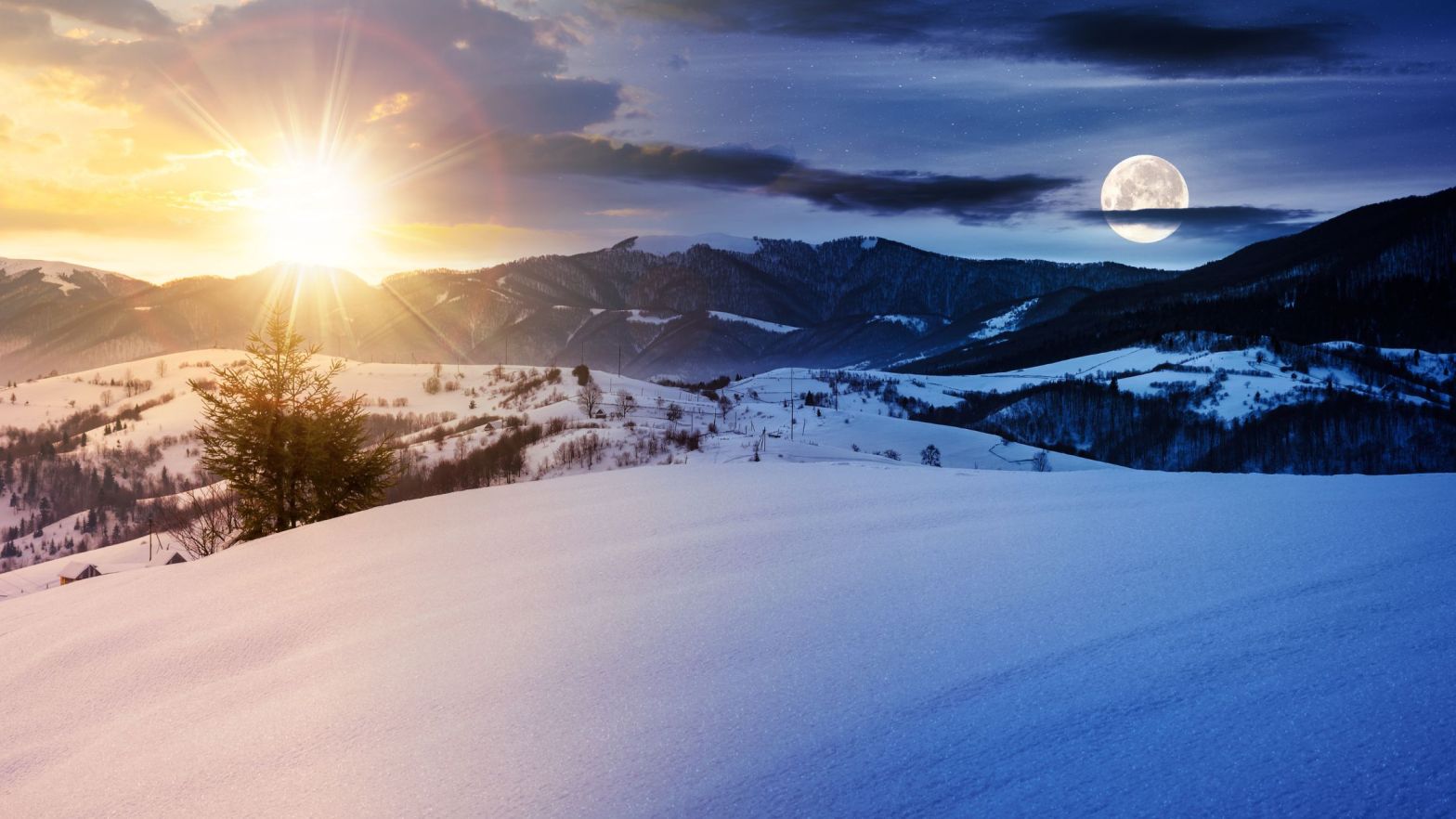
December 21st, 2025. The winter solstice. The longest night of the year in the Northern Hemisphere.
For thousands of years, humans have marked this moment not with fear but with celebration. Because while December 21st is the darkest day, it’s also a turning point: from here forward, the days grow longer. Light begins its slow return.
Christians light Advent candles and celebrate Christ’s birth. Jews light the menorah for eight nights of Hanukkah. Ancient pagans lit bonfires for Yule. Romans honored Sol Invictus, the “unconquered sun.” Persians celebrated Yalda. Indigenous cultures worldwide marked the solstice with ceremony and firelight.
Same season. Same symbolism. Different stories.
What if the deepest truths transcend any single tradition? What if the search for light in darkness is the most universal human experience we have?
And what does that mean for how we understand faith, belief, and the stories we inherit?
The Winter Solstice: Nature’s Darkest Moment
Let’s start with the science, because the science is profound.
Earth’s axis tilts 23.5 degrees. As we orbit the sun, this tilt means that for half the year, the Northern Hemisphere leans toward the sun (summer), and for half the year, it leans away (winter).
The winter solstice occurs when the North Pole is tilted farthest from the sun. The result: the shortest day and longest night of the year.
For ancient peoples without electric lights, without central heating, without the technological buffers that insulate modern humans from nature’s rhythms, this was existential.
Would the sun return? Would warmth come back? Would crops grow again?
They didn’t have astrophysics to reassure them. They had observation, tradition, and faith.
So they lit fires. They told stories. They created rituals to mark the turning point, the moment when darkness reaches its peak and light begins its return.
Every major religion grew from cultures that needed to make meaning of this moment.

Christmas: The Christian Response to Darkness
Let’s address the obvious: Jesus was not born on December 25th.
Biblical scholars generally agree that if the Gospel accounts are historically accurate, Jesus was likely born in spring or early fall (shepherds wouldn’t be “keeping watch over their flocks by night” in winter).
So why December 25th?
Because the early Christian church was smart about cultural adaptation.
Sol Invictus and the Unconquered Sun
In 274 CE, Roman Emperor Aurelian established December 25th as the feast of Sol Invictus, the unconquered sun. This celebration marked the moment when the sun begins its “rebirth,” growing stronger each day after the solstice.
Early Christians, evangelizing in a Roman-dominated world, co-opted this date. They reframed it: the light being born isn’t the physical sun. It’s the “light of the world”, Christ.
Saturnalia: Rome’s Winter Celebration
Before Sol Invictus, Romans celebrated Saturnalia in mid-December: a festival of gift-giving, feasting, role reversals, and temporary social equality.
Sound familiar?
The Christmas traditions we practice, gift exchange, feasting, and decorating with greenery, aren’t originally Christian. They’re adaptations of pre-existing winter celebrations.
The Symbolism: Light Conquering Darkness
But here’s what matters: the Christians weren’t just stealing holidays. They were recognizing something true.
The metaphor of light conquering darkness resonates because it’s human, universal, and profound.
In John 1:5, the Gospel writer proclaims: “The light shines in the darkness, and the darkness has not overcome it.”
This isn’t just about Jesus. It’s about hope. About the human refusal to let darkness have the final word.
Hanukkah: The Jewish Festival of Lights
Hanukkah, the Festival of Lights, commemorates a specific historical event: the rededication of the Second Temple in Jerusalem around 165 BCE after the Maccabean revolt against Greek-Syrian oppression.
According to tradition, when the Jews reclaimed the temple, they found only enough consecrated oil to keep the menorah lit for one day. Miraculously, it burned for eight.
The Deeper Symbolism
But like Christmas, Hanukkah’s timing isn’t accidental.
It falls near the winter solstice. It involves lighting candles in darkness, one more each night until all eight are lit.
The historical specificity (the Maccabean revolt) is important. But the metaphor transcends it:
Light persists against impossible odds. Hope surviving oppression. The refusal to let darkness win.
This is why Hanukkah resonates beyond its historical moment. It speaks to the universal human experience of resisting forces that try to extinguish your light.
Yule: The Pagan Celebration of Rebirth
Long before Christianity reached Northern Europe, Germanic and Scandinavian peoples celebrated Yule: a midwinter festival marking the solstice.
The Yule Log
Families would burn a massive log throughout the longest night, symbolizing the sun’s warmth and ensuring its return. Celebrations included feasting, decorating with evergreens (symbols of life persisting through winter), and honoring the cyclical nature of death and rebirth.
What Christianity Absorbed
When Christianity spread north, it didn’t erase these traditions. It absorbed them.
The Yule log became a Christmas tradition.
Evergreen decorations became Christmas trees.
The concept of winter feasting became Christmas dinner.
Why? Because the underlying truth remained the same: humans need rituals to mark the turn from darkness to light.
The stories changed. The symbolism endured.
Other Cultures, Same Truth
Yalda Night (Persian/Zoroastrian)
In Iran and surrounding regions, Yalda Night (Shab-e Yalda) celebrates the longest night. Families gather, eat pomegranates and watermelon (symbols of the sun), read poetry, and stay awake to welcome the sun’s rebirth.
The celebration predates Islam and connects to Zoroastrian cosmology: the eternal battle between light (Ahura Mazda) and darkness (Angra Mainyu).
Dongzhi Festival (East Asian)
In China, Taiwan, Japan, Korea, and Vietnam, the Dongzhi Festival marks the winter solstice with family gatherings and specific foods (like tangyuan, glutinous rice balls symbolizing reunion and completion).
The philosophical foundation comes from yin and yang: at the solstice, yin (darkness) reaches its peak, but from this moment, yang (light) begins to grow.
Soyal (Hopi)
The Hopi people of the American Southwest perform the Soyal ceremony to symbolically turn the sun back toward summer. It involves purification rituals, prayer, and the Kachinas (spiritual beings) returning to the village.
Inti Raymi (Incan, Southern Hemisphere)
While the Northern Hemisphere experiences the winter solstice in December, the Southern Hemisphere experiences it in June. The Inca celebrated Inti Raymi, the Festival of the Sun, to honor the sun god Inti and pray for the sun’s return.
Same impulse. Different hemisphere. Universal human need.

What This Reveals About Faith and Truth
Here’s where it gets philosophically interesting.
If every major religion and culture has a winter festival celebrating light conquering darkness, what does that tell us?
Option 1: They’re All Copying Each Other
Maybe. Cultural diffusion happens. Traditions spread through conquest, trade, and migration.
But that doesn’t explain why geographically isolated cultures (Hopi in North America, Incas in South America, Zoroastrians in Persia) independently developed similar symbolism.
Option 2: They’re All Responding to the Same Human Experience
This seems more likely.
Humans everywhere experience darkness. Literally (winter) and metaphorically (suffering, uncertainty, grief).
Humans everywhere crave light. Literally (the sun’s return) and metaphorically (hope, meaning, transcendence).
The specific stories differ. The underlying truth remains constant.
Option 3: There’s Something Transcendent Being Expressed Imperfectly
This is where it gets interesting for people of faith.
What if all these traditions, Christian, Jewish, Pagan, Zoroastrian, Hopi, Incan, are different cultures trying to express the same transcendent reality?
What if “God” or “the Divine” or “ultimate truth” is bigger than any single tradition’s ability to capture it?
What if the light metaphor appears universally because it’s pointing to something real, something that every human culture intuitively recognizes, even if we name it differently?
What Joseph’s Letter Asks About Universal Truth
In Joseph’s Letter, Michael Battersby searches for proof of Christian resurrection. But his journey forces him to confront a bigger question:
What if the truth is more complex than any single religious tradition admits?
Michael isn’t trying to destroy faith. He’s trying to find an authentic belief that can withstand scrutiny.
And what he discovers, what many seekers discover, is that institutional religion often demands exclusive truth claims that reality doesn’t support.
“Only Christians have the real story.”
“Only Jews understand God’s covenant.”
“Only our tradition holds the key.”
But when you step back and look at humanity’s collective wisdom traditions, you see patterns. You see the same truths emerging independently across cultures:
– Light conquers darkness
– Love transcends death
– Meaning can be found in suffering
– The divine reveals itself in vulnerability
– Community matters more than individual triumph
What if these recurring patterns aren’t accidents? What if they’re pointing to something true?
How to Honor the Solstice in 2025 (Regardless of Your Beliefs)
You don’t have to abandon your tradition to recognise the universal truth it participates in.
A Christian can celebrate Christmas and acknowledge that the light metaphor predates Christianity.
A Jew can honor Hanukkah and recognize similar celebrations worldwide.
A secular person can mark the solstice and appreciate the deep human wisdom in these traditions.
1. Acknowledge the Darkness
December 21st is the longest night. Don’t rush past it.
What darkness are you carrying? What uncertainty? What grief?
Sit with it. Name it. Honor it.
2. Light a Candle (Literally or Metaphorically)
You don’t need a religious framework to recognise the power of lighting something small in the dark.
Light a candle. Build a fire. Turn on a lamp.
And as you do, acknowledge: I am choosing to create light in my own darkness.
3. Connect With Others
Every winter celebration involves community. Gathering. Feasting. Sharing warmth.
Don’t isolate. Reach out. Share the longest night with someone.
4. Tell Stories
Humans are story-making creatures. We need narratives to make meaning of experience.
What story are you telling yourself about this dark season of your life? Is it a story of despair? Or is it a story of waiting for light’s return?
You get to choose the narrative frame.
5. Trust the Turning
The solstice is a turning point. After this, light returns.
Not all at once. Not immediately. But slowly, steadily, inevitably.
Whatever darkness you’re in, personal, spiritual, collective, it won’t last forever.
The earth turns. The seasons change. Light comes back.
Trust the turning.
Reflection Questions: What Light Are You Waiting For?
💭 What do you make of the fact that every culture celebrates light conquering darkness?
Coincidence? Cultural diffusion? Or something deeper?
💭 Can you honor your own tradition while recognising universal patterns?
Does acknowledging similarity diminish uniqueness, or does it reveal deeper truth?
💭 What darkness in your life feels like the longest night?
Where are you waiting for the light to return?
💭 If all religions are responding to the same human experience, what does that mean for exclusive truth claims?
Can multiple traditions be “true” simultaneously?
💭 What small light can you create in your own darkness today?
Not a solution. Not a transformation. Just one small candle.
The Search for Light Continues
Joseph’s Letter is ultimately about the search for light in darkness, for proof that death isn’t the end, that love survives, that meaning exists even in grief.
Michael Battersby’s journey takes him across continents, through ancient texts, and into Vatican secrets. But what he’s really searching for is the same thing humans have always searched for:
The conviction that darkness doesn’t get the final word.
That’s Christmas. That’s Hanukkah. That’s Yule. That’s Yalda. That’s Dongzhi. That’s every winter celebration humanity has ever created.
Different stories. Same truth.
📖 Download the first chapter and join Michael’s search for light in the darkness.
Join the Conversation About Universal Truth
The search for light is better when we walk it together, across traditions, across beliefs, across differences.
If this post resonated with you:
✅ Share this post with someone navigating their own spiritual questions
Because the light belongs to all of us.
About the Author:
Robert Parsons is the author of Joseph’s Letter, a novel exploring faith, doubt, and the search for truth that transcends institutional boundaries. After decades of teaching comparative religion to adolescents, Robert understands that authentic faith can honour tradition while recognising universal patterns. His mission is simple: encourage people to think outside the box about religion, seek truth wherever it appears, and build bridges between traditions rather than walls.
 Robert Parsons